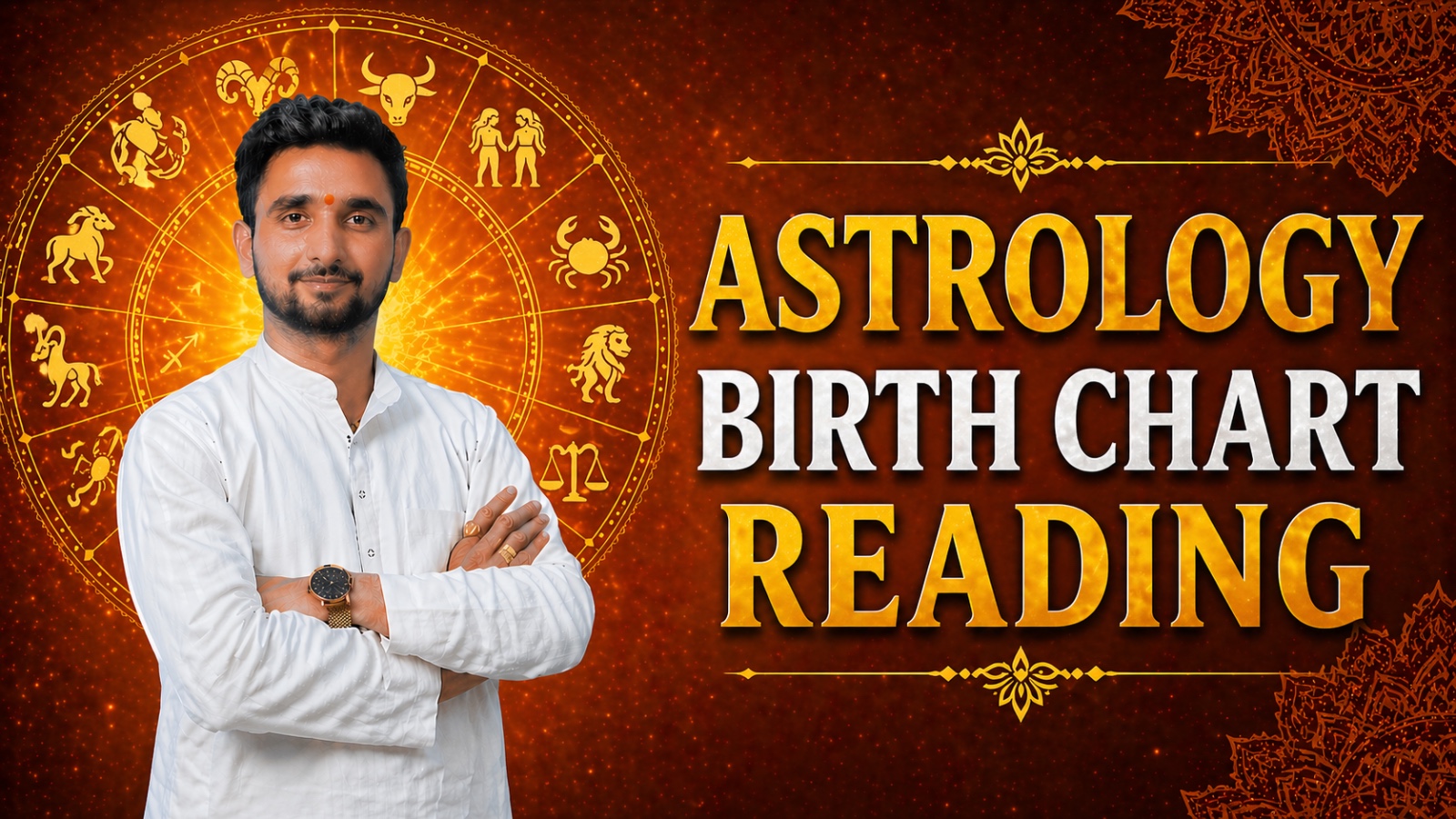
Most people know their sun sign. But if that is all you are reading, you are missing about 90% of your story. An astrology birth chart reading is where things get genuinely fascinating and deeply personal.
Your birth chart is essentially a photograph of the sky at the exact moment you were born. Every planet, every sign, every degree frozen in time. It is not generic. It is yours alone. At Astro Shivang, we have seen how a proper chart reading can shift someone's entire perspective on why they think, feel, and behave the way they do.
What Is an Astrology Birth Chart Reading?
A birth chart (also called a natal chart) is a circular map divided into 12 houses. Each house governs a different area of life, including your identity, finances, relationships, career, spirituality, and more. Overlaid on those houses are the 12 zodiac signs, and placed within them are the planets at the time of your birth.
When an astrologer does a birth chart reading, they are interpreting how all of these layers interact. It is not just "you are a Scorpio so you are intense." It is more like: your Sun is in Scorpio in the 8th house, your Moon is in Gemini, and your Mercury squares Saturn, which paints a very specific picture of how you process emotion, communicate, and relate to authority.
Think of it like a fingerprint. Two people born on the same day can have wildly different charts if they were born hours apart or in different cities.
Why Your Birth Time and Location Matter So Much
Here is something I have noticed that surprises a lot of first-timers: the birth time is not optional. It is critical.
The Ascendant (or Rising Sign) changes every two hours. This sign determines your entire house structure. Get the time wrong by even 30 minutes, and your chart shifts meaningfully. In my experience, clients who dig up their exact birth certificate before a session always walk away with far more precise and resonant insights.
If you genuinely do not know your birth time, there is a technique called chart rectification where an astrologer works backward from key life events to estimate it. It takes longer, but it works.
Three pieces of information you always need:
- Date of birth (day, month, year)
- Exact time of birth (as precise as possible)
- Place of birth (city and country)
The Key Components of a Birth Chart Reading
1. The Sun, Moon, and Rising Sign
These three are called the "big three" and they form the core of your personality blueprint.
Your Sun sign represents your core identity and ego, essentially what you are growing into. Your Moon sign reveals your emotional world, instincts, and what makes you feel safe. Your Rising sign (Ascendant) is your outer mask, meaning how others see you before they really know you.
When I tried reading just sun signs for years before discovering full chart readings, the descriptions always felt half-right. The moment I added the Moon and Rising, everything clicked into place.
2. Planetary Placements and Houses
Each planet carries a specific energy. Mars is drive and aggression. Venus is love and aesthetics. Saturn is discipline and karma. Where these planets sit in your chart, and in which house, shapes how that energy plays out in your actual life.
For example, Venus in the 2nd house suggests someone who finds deep pleasure in material comfort and financial security. The same Venus in the 7th house shifts that energy entirely toward partnerships and relationships.
3. Aspects: How the Planets Talk to Each Other
Aspects are the geometric angles between planets. A trine (120 degrees) suggests harmonious flow. A square (90 degrees) creates friction and tension that often drives growth. An opposition (180 degrees) pulls you in two directions simultaneously.
According to research published in the Journal of Consciousness Studies, symbolic systems like astrology can serve as meaningful frameworks for self-reflection and identity formation when used thoughtfully. A skilled astrologer does not just list aspects. They weave them into a coherent narrative about your strengths, challenges, and growth edges.
What a Birth Chart Reading Can Actually Tell You
This is where people get surprised. A thorough astrology birth chart reading is not just about personality. It touches almost every area of life.
Career and life purpose: The 10th house and its ruler point toward your public role and vocation. Planets like Jupiter and Saturn here carry enormous weight about ambition and responsibility.
Relationships and compatibility: The 7th house governs partnerships. Your Venus and Mars placements shape what you are attracted to and how you pursue it.
Health tendencies: The 6th house and certain planetary placements can point toward areas requiring more attention or care.
Karmic patterns and past life indicators: The North and South Nodes in your chart are arguably the most profound indicators of your soul's direction and what you are meant to move away from.
At Astro Shivang, the approach to birth chart readings always starts with what the client is genuinely seeking clarity about. The chart has layers, and not every layer is equally relevant to every person at every stage of life.
Vedic vs Western Astrology Birth Charts
A question that comes up constantly: which system should you use?
Western astrology uses the Tropical zodiac, which is based on the seasons and the Sun's position relative to Earth. Vedic astrology (Jyotish) uses the Sidereal zodiac, which tracks actual star positions. This creates roughly a 23-degree difference between the two systems, meaning your Sun sign might change when you switch from Western to Vedic.
Neither is "more correct." They are different lenses. Western astrology tends to focus on psychological patterns and identity. Vedic astrology emphasizes timing, karma, and life events through its powerful Dasha system.
I have noticed that clients who are primarily interested in self-understanding often resonate more with Western readings, while those seeking timing guidance tend to find Vedic readings more immediately practical.
How to Prepare for Your First Birth Chart Reading
Getting the most from a reading takes a little preparation. Here is what genuinely helps:
- Confirm your birth details — a birth certificate is the gold standard
- Write down 2 to 3 specific areas of life you want explored — vague questions get vague answers
- Come with an open mind, not a test mindset — you will get more if you are collaborating, not trying to catch the astrologer out
- Take notes or ask to record the session — there is a lot of information and it is easy to forget the nuances
- Give it a few days to integrate — some insights land immediately, others take a week to fully make sense
Reading Your Chart Yourself: Where to Start
If you want to begin exploring on your own, start with free chart generation tools. Enter your birth data, and you will get a visual chart along with a planet-by-planet breakdown.
Begin with your big three. Read about your Sun sign's house placement, not just the sign itself. Then look at where Saturn sits. In my experience, Saturn's house and sign reveal more about your life's central lesson than almost anything else in the chart.
Do not try to interpret everything at once. The chart is a lifelong companion, not a one-time read.
About the Author
Shivang is a Vedic and Western astrologer with over 12 years of experience in natal chart readings, compatibility analysis, and predictive astrology. Trained in classical Jyotish and modern psychological astrology, he has worked with thousands of clients across India and internationally through Astro Shivang, helping them find clarity at major life crossroads.