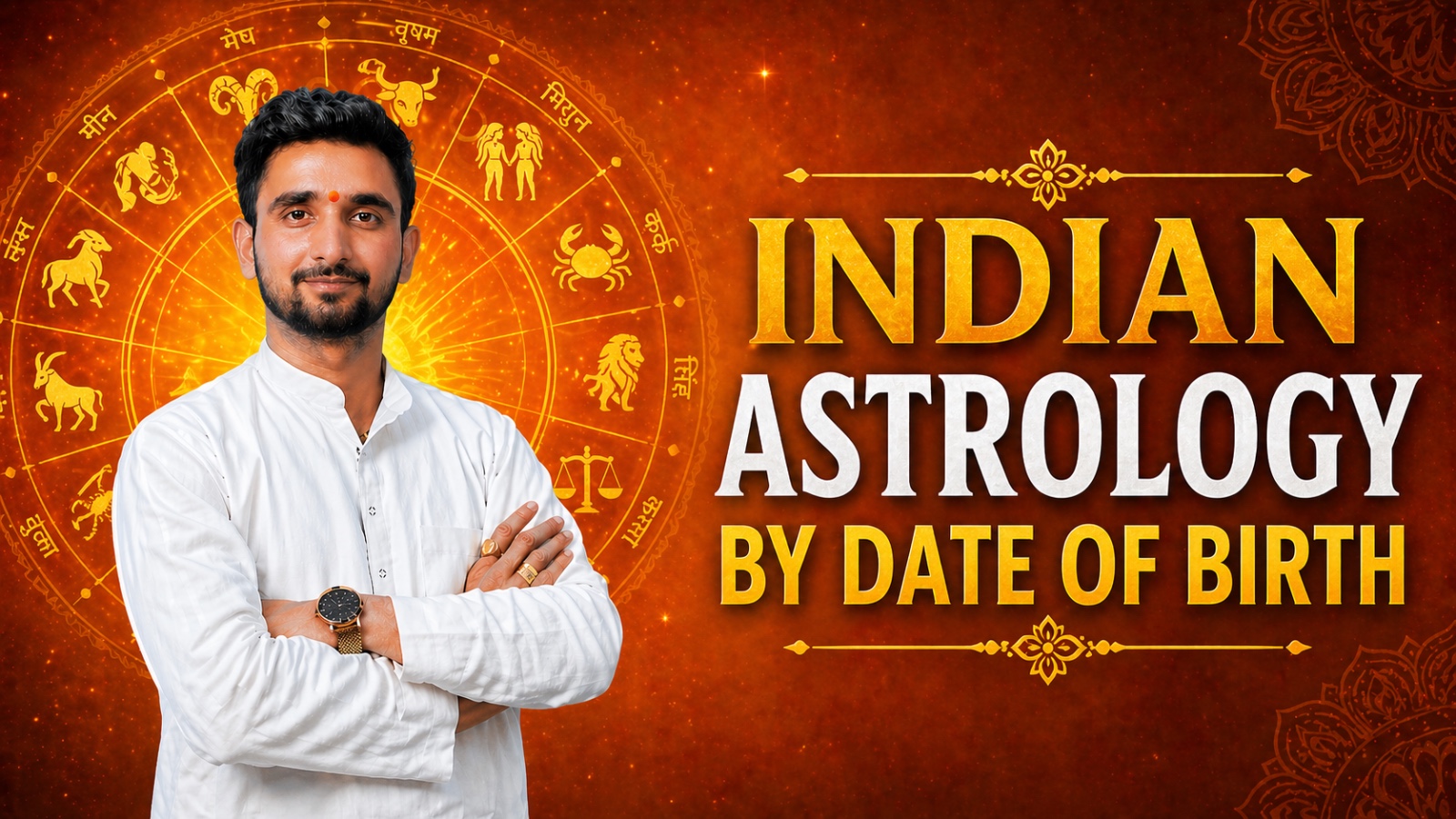
Most people know their sun sign. Very few know what their birth chart is actually telling them. Indian astrology by date of birth goes far deeper than any generic horoscope column ever could, and once you understand how it works, you will never look at your birthday the same way again.
Rooted in thousands of years of observation and tradition, Vedic or Indian astrology uses your exact date, time, and place of birth to create a precise cosmic map of your life. It is not about vague personality traits. It is about timing, planetary influence, and understanding the specific energies that shape your journey.
What Is Indian Astrology by Date of Birth?
Indian astrology, known formally as Jyotish Shastra, translates to "science of light." It is one of the six Vedangas, meaning it is considered a limb of the ancient Vedic scriptures. That alone tells you how seriously this system has been taken for millennia.
Unlike Western astrology, which divides the year into twelve sun signs based on seasons, Indian astrology uses the Sidereal zodiac, which tracks the actual positions of constellations in the sky. This creates roughly a 23-degree difference between the two systems, which is why your sun sign in Indian astrology often differs from what your Western horoscope says.
When you provide your date of birth to an Indian astrologer, here is what they actually build:
- Your Lagna (Ascendant): The zodiac sign rising on the eastern horizon at your birth moment
- Your Moon sign (Rashi): The sign the Moon occupied at birth, which governs your emotional nature
- Your Navamsha chart: A divisional chart that reveals deeper soul-level truths, especially about relationships
- Your Dasha timeline: A planetary period system that maps out which planet governs specific phases of your life
Each of these layers adds specificity. Together they give a picture no daily horoscope column can match.
Why Your Date of Birth Matters More Than You Think
Here is something I find myself explaining often: your date of birth is just one piece of the puzzle, but it is the foundation everything else rests on.
In my experience, even a basic analysis using only the date of birth can reveal surprisingly accurate personality traits, karmic tendencies, and broad life themes. When the birth time is added, the reading sharpens dramatically. The Ascendant changes every two hours, so even twins born 90 minutes apart can have very different charts.
Think of your birth date as the seed and your birth time as the soil conditions. The seed tells you what kind of plant will grow. The soil conditions tell you how it will actually develop.
At Astro Shivang, readings always begin with a full chart construction, not just a sun sign lookup. That commitment to depth is what separates a meaningful reading from a generic one.
Indian Astrology Career Prediction by Date of Birth
One of the most searched topics in Vedic astrology is career prediction. And honestly, it makes sense. People want to know if they are on the right path.
Indian astrology by date of birth identifies career suitability through several key chart factors:
- The 10th house and its ruling planet indicate your professional life, public image, and ambitions
- The 6th house governs daily work, service, and competitive ability
- Saturn's placement reveals discipline, hard work, and areas where persistence pays off
- Mercury and Jupiter indicate fields involving communication, teaching, law, and finance
When I tried analyzing career charts for people who felt stuck professionally, I found a recurring pattern: Saturn was either transiting or aspecting their 10th house, creating what astrologers call a period of restructuring rather than growth. Understanding that distinction changes everything. Instead of panic, you get patience.
A 2019 survey by the Indian Council of Astrological Sciences found that over 78 percent of respondents consulted an astrologer at least once for career-related guidance, reflecting just how deeply this tradition remains embedded in decision-making across India and the Indian diaspora globally.
Marriage and Relationship Predictions Through Indian Astrology
Relationships are where most people first turn to astrology. And Indian astrology has a remarkably sophisticated system for analyzing them.
The 7th house in your birth chart governs marriage, partnerships, and significant relationships. The planet ruling that house, its placement, and any planets sitting in or aspecting the 7th house all influence your relationship experiences.
Venus matters enormously here. Its sign, house placement, and dignity in your chart tell an astrologer a great deal about what you seek in a partner and how you experience love. Jupiter for women in traditional Vedic analysis, and Venus for men, are considered the natural significators of the spouse.
I have noticed that people who come in asking about relationship timing often already sense something intuitively. The chart tends to confirm what they feel. Rarely does it completely contradict a person's lived experience.
Wealth and Financial Predictions in Indian Astrology
Financial astrology is a serious branch within the Jyotish tradition. Your birth chart holds specific indicators that point toward your earning potential, relationship with money, and periods of financial growth or caution.
Key Houses for Wealth Analysis
The 2nd house represents accumulated wealth, savings, and the family financial legacy you inherit or build. The 11th house governs income, gains, and the fulfillment of material desires. When both houses and their lords are strong and well-placed, it is generally a positive signal for financial stability.
Jupiter is the planet most associated with abundance in Indian astrology. When it transits a favorable house or aspects your natal wealth indicators, financial growth tends to follow. That timing insight is precisely why Astro Shivang focuses so heavily on Dasha and transit analysis alongside the natal chart.
How the Dasha System Makes Indian Astrology Uniquely Powerful
No other astrological system has anything quite like the Vimshottari Dasha system. This is where Indian astrology truly stands apart.
The Dasha system divides your entire life into planetary periods totaling 120 years. Each planet rules a specific period, ranging from six years for the Sun to twenty years for Venus. Within each major period are sub-periods ruled by other planets, creating a layered timing framework of remarkable precision.
Here is a real example of how this works. Saturn's major period lasts nineteen years. During that time, Saturn's qualities, whether discipline, delay, hard work, or restriction, color nearly every area of life. But within that Saturn period, a Jupiter sub-period of about two and a half years can bring genuine relief, expansion, and opportunity. Knowing when those windows open is invaluable.
When I tried tracking Dasha periods against major life events for clients over several years, the correlation was consistent enough to be genuinely striking. Job changes, marriages, relocations, health shifts, all mapped neatly onto planetary period transitions.
How to Get an Accurate Indian Astrology Reading
To get the most out of any reading, you will need:
- Date of birth: Day, month, and year
- Time of birth: As precise as possible, ideally from a birth certificate
- Place of birth: City and country, which helps calculate the exact degree of the Ascendant
If you do not have your birth time, a technique called birth time rectification can help estimate it using major life events as reference points. It is not as precise as a confirmed birth time, but it is far better than working without one.
Indian Astrology vs. Western Astrology: The Key Differences
People often ask which system is better. The honest answer is that they are different tools built on different philosophical foundations.
Western astrology excels at psychological profiling. It is rich in archetypal symbolism and tends to focus on the inner world. Indian astrology, by contrast, is built for prediction. Its Dasha system, divisional charts, and transit analysis give it a precision for timing events that Western astrology does not replicate.
That is not a criticism of either. It is just an honest acknowledgment that if you want to know when something is likely to happen, Indian astrology by date of birth is the more precise instrument.
Final Thoughts
Your date of birth is not just a piece of administrative information. In the Vedic tradition, it is a record of the cosmos at the moment you arrived. Every planet, every degree, every house tells part of your story.
Whether you are navigating a career crossroads, a relationship question, or simply curious about what your chart says, Indian astrology by date of birth offers a framework that is both ancient and surprisingly practical.
Explore your chart. Ask the deeper questions. The answers have been written in the sky since the day you were born.
Author Bio: Astro Shivang is a practicing Vedic astrologer with over 12 years of experience in Jyotish, Kundli analysis, and predictive chart reading. Trained in classical Indian astrological traditions, Shivang has consulted with thousands of individuals across India, Australia, and beyond, helping them navigate life's most important decisions through the lens of Vedic wisdom.