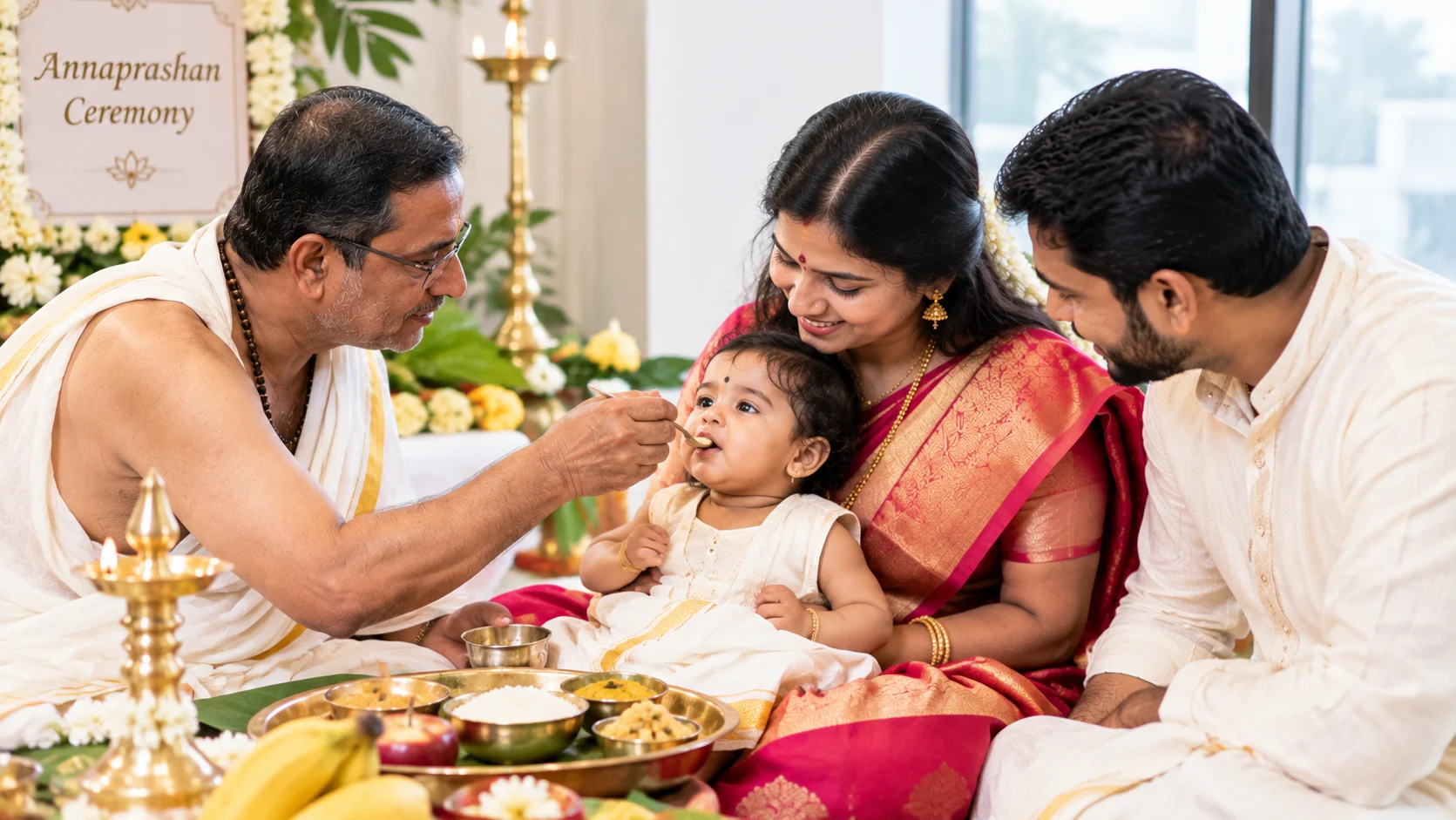
This guide explains the meaning, the traditional timing, how muhurat is chosen, what to serve and how to host the day in Australia. You'll also find common myths cleared up and answers to the questions parents ask most often.
Annaprashan Ceremony Meaning: More Than a First Taste
The name says it plainly. "Anna" means food or grain, and "prashana" means feeding, so the annaprashan ceremony is the first feeding of grain. You'll also see it spelt annaprasana or Annaprashana, and regional names such as Mukhe Bhaat in Bengal and Choroonu in Kerala.
It's one of the sixteen sanskars, the life-cycle rites in Hindu tradition. The page on Vedic Child – 16 Sanskars shows where it sits in the sequence.
In traditional belief, food is sacred and life-giving, so the baby's first grain is offered with prayers of gratitude and a wish for health and strength. That is a religious and cultural meaning, not a nutritional claim, and it works alongside your baby's usual feeding.
Is Your Baby Ready? Where Tradition Meets Australian Health Advice
Before you fix a date, it helps to look at your baby, not just the calendar. Australian infant feeding guidelines, developed by the NHMRC, advise starting solids at around six months and not before four months. The sixth-month tradition and that advice happen to line up well.
Signs your baby may be ready include:
- Sitting upright with support and holding their head steady
- Showing interest when you eat
- Opening their mouth when a spoon approaches
- Pushing food out with the tongue less than before
If some of these are missing, don't push. The ritual can be moved slightly or kept symbolic, with a tiny taste from the tip of a spoon. Your child health nurse or GP can help you judge readiness.
Choosing the Right Month and Date
Traditionally the ceremony is held around the sixth month after birth. Some traditions prefer even months such as the sixth or eighth for boys, and odd months such as the fifth or seventh for girls, while many families simply choose the sixth month for both.
One pattern I often see is parents feeling they must hit the exact day the baby turns six months. Tradition is far more flexible than that. A suitable window of a few weeks is normal, and it gives you room to choose a good muhurat and a settled baby.
Annaprashan Muhurat 2026: How to Find a Suitable Date
Searches for annaprashan muhurat 2026 usually return long lists of dates. Those lists are generic. In traditional Vedic astrology, a suitable time is calculated from the panchang (tithi, nakshatra and weekday) and may also consider the baby's birth details.
Here's a practical way to do it:
- Note your baby's date, time and place of birth.
- Work out the month range that suits your family's custom.
- Ask a pandit for two or three suitable dates inside that range.
- Confirm the timing is calculated for Melbourne, not India.
- Choose the option that suits your baby's feeding and nap pattern.
Local timing matters because sunrise and sunset differ by place. Victoria also moves its clocks for daylight saving during the year, so double-check the time in local terms. Astrologers may interpret the chart to prefer certain windows, but this is guidance, not a guarantee of any outcome.
What Happens on the Day: A Simple Walkthrough
Every family does things a little differently, but most ceremonies follow this pattern:
- Setting up: A clean, quiet space is prepared with a small altar, lamp and the prepared food.
- Prayers: The family invokes Lord Ganesha and the family deity.
- The offering: The rice or kheer is first offered to the deity as prasad.
- The first taste: Traditionally the father, a grandparent or the maternal uncle feeds the baby a small spoonful.
- Blessings: Elders bless the child, and relatives may offer small gifts.
- The family meal: Everyone shares prasad and a meal together.
In some Bengali families the child is also shown a few objects, such as a book or pen, and whichever one they reach for is treated as a playful sign. It's a light-hearted custom, not a prediction.
What to Serve, and What to Skip
Kheer or payasam is the classic first food, but a baby's first taste should be gentle. Keep a few simple rules in mind:
- Make it smooth, soft and thin, with no lumps or whole nuts.
- Skip honey, which is not recommended for babies under twelve months.
- Leave out added salt, and keep sugar or jaggery minimal.
- Ask your child health nurse about dairy in the recipe and how to introduce common allergens such as egg and peanut.
- Keep your baby upright and supervised while eating.
- Serve the baby a separate small portion, apart from the celebration sweets.
A single spoonful is enough. Breastmilk or formula remains your baby's main nutrition at this stage.
Hosting an Annaprashan Ceremony in Melbourne
Families here usually choose between a home ceremony, a community hall and a temple. Home is calm and familiar, and it suits a small circle. A hall makes sense for a larger guest list, though it's worth asking about rules on open flame.
A few practical points help:
- Schedule the ceremony after a feed and nap, not before.
- Keep the room warm on a cold Melbourne day.
- Plan vegetarian catering, since most families expect it at a Hindu ceremony.
- Let grandparents join by video if they're overseas.
If you're searching for an annaprashan ceremony pandit near me, look for someone who can explain each step, calculate timing for Melbourne and adapt the rites to your space. Astro Shivang is based in Truganina and also works with families across Australia. Our page on Hindu Priest for Home Ceremonies explains what a home ceremony involves.
Myths and Misunderstandings
- "It must be on the exact sixth-month day." It doesn't. A short window is normal.
- "The baby has to eat a lot." A tiny taste is the whole point.
- "After this, the baby moves fully to solids." No. Milk feeds remain central for a good while.
- "Missing the date brings bad luck." Tradition is flexible for genuine reasons such as illness or travel, and there's no reason for fear.
When a Pandit's Guidance Helps
You can offer simple prayers yourself, but many parents prefer a Hindu Pandit in Melbourne for the right mantras, sequence and timing. Families comparing options sometimes look at our page on the Best Indian Pandit in Melbourne as well, and it's sensible to ask any pandit how they'd handle your specific situation.
In my experience, families who share their customs and their baby's routine early end up with a calmer ceremony. Have ready your baby's birth details, your preferred dates, expected guest numbers, the venue and any dietary needs.
Planning Your Baby's First Rice Ceremony with Confidence
Choose a window that suits your baby, keep the food gentle and get the timing calculated for Melbourne. The rest is warmth, prayer and a small spoonful of rice.
If you'd like to talk it through, Astro Shivang is happy to help you understand the rites and plan the day. You can reach us on +61 433 710 113 whenever you're ready.