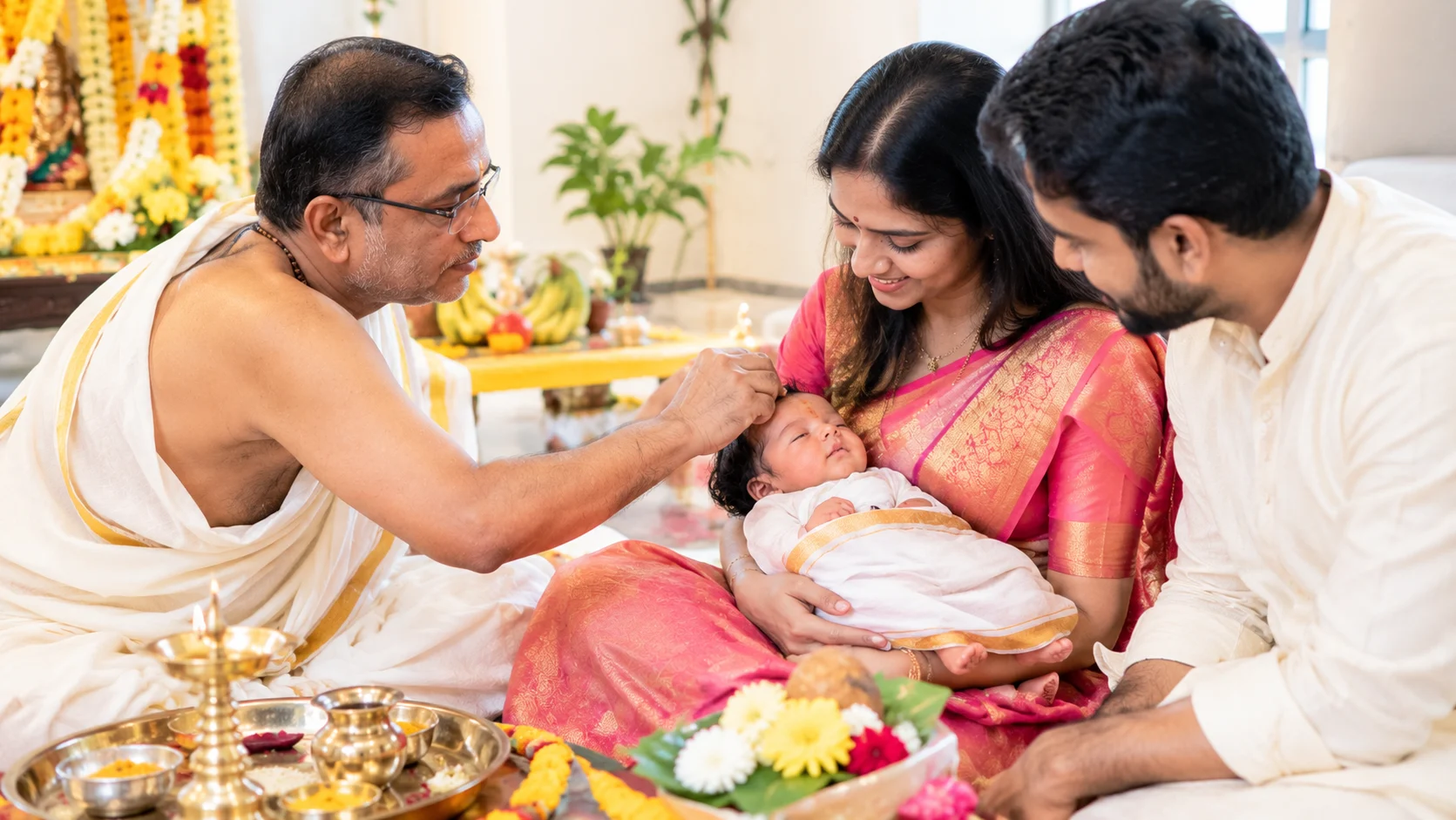
This guide walks through each stage from pregnancy to the first few years, explaining what the ritual means, when it's traditionally done and how families here adapt it. You'll also find guidance on timing, common worries and when a pandit's help is worth having.
What Are Hindu Birth Rituals?
Birth rituals in Hinduism belong to a larger set of life-cycle rites called sanskars. The word suggests refinement: each rite is meant to bless a stage of life and prepare the person for the next. Together they form the Hindu rites of passage, running from before birth to the final rites at the end of life.
Different texts and communities list them slightly differently, but the sixteen sanskars are the most common framework. The page on Vedic Child – 16 Sanskars sets out the full sequence.
These are religious and cultural traditions. They express hope, gratitude and blessing, and shouldn't be read as medical or scientific claims.
Why These Rituals Still Matter to Families in Australia
For many parents in Australia, the rituals are a way of handing something familiar to a child who is growing up far from the extended family. Grandparents who can't travel may join by video call, and the ceremony gives everyone a shared moment even across time zones.
There's a quieter benefit too. A birth is exhausting, and a simple ritual gives the family a pause to give thanks, name their hopes and welcome the baby together.
The Birth Rituals at a Glance
Timings below are traditional descriptions. Families and regions differ, so treat them as a starting point.
- Pumsavana: a prayer for the baby's wellbeing, traditionally in the third month of pregnancy.
- Simantonnayana: a blessing for mother and baby in mid-pregnancy, often linked to modern baby-shower customs.
- Jatakarma: the welcome rite at birth.
- Namakarana: the naming ceremony, traditionally in the first two weeks.
- Nishkramana: the baby's first outing, around the third or fourth month.
- Annaprashana: the first solid food, around the sixth month.
- Chudakarana (mundan): the first haircut, often in an odd year of the child's life.
- Karnavedha: ear piercing, in the early years of childhood.
Stage by Stage: What Each Ritual Involves
Rituals During Pregnancy
Pumsavana and Simantonnayana are prayers for a healthy pregnancy and a safe delivery. Simantonnayana traditionally involves parting the mother's hair and offering blessings, and many families now hold it as a gentle gathering for the mother.
Neither ritual replaces medical care. Keep your antenatal appointments, and think of these rites as an added layer of blessing.
Jatakarma: Welcoming the Newborn
Jatakarma is performed soon after birth. Traditionally the father whispers a blessing and touches honey and ghee to the baby's tongue.
Please take care with this one. Health authorities advise against giving honey to babies under twelve months, so families today usually make the gesture symbolic and rely on prayers and mantras instead. Check with your midwife or doctor about anything that touches the baby.
Namakarana: The Naming Ceremony
Traditionally held around the eleventh or twelfth day, though some families choose another day in the first weeks or later in the year. Many families begin with the birth nakshatra, which is associated with a starting syllable, then choose a name that feels meaningful and works well in Australia.
The ceremony announces the name to family. Legal registration with the state registry, such as Births, Deaths and Marriages Victoria, is a separate step.
Nishkramana: The First Outing
Around the third or fourth month, the baby is taken outdoors for the first time, often to see the sun and offer thanks. In Melbourne, that can be as simple as a walk in the garden, or a visit to a temple, wrapped up warmly.
Annaprashana: The First Grains
Often called the first rice ceremony, this marks the start of solid food, traditionally around the sixth month. Parents offer a small taste of prepared rice or kheer after prayers.
Check that your baby is developmentally ready for solids and follow your child health nurse's advice on textures and allergens. A symbolic taste is enough.
Chudakarana and Karnavedha
Chudakarana (mundan) is the first haircut, and Karnavedha is ear piercing. Both are usually done in the early years, and the timing varies a lot by family. Our page on the mundan ceremony in Melbourne covers the first in detail.
Adapting Traditional Rituals to Life in Melbourne
Most of the traditional descriptions assume a home birth, a full house and an entire community nearby. Your reality may be a hospital ward, a two-bedroom unit and relatives overseas. That's fine.
Families here often do the following:
- Offer prayers and mantras quietly at the bedside, and complete the ritual at home later.
- Keep the ceremony small, so mother and baby aren't overwhelmed.
- Check building rules before using a havan or open flame in an apartment.
- Use video calls so distant grandparents can watch and bless.
- Choose the weekend after the muhurat window when possible, but not before it.
In my experience, families who talk to a pandit early tend to settle on a practical plan without feeling they've compromised the ritual. If you'd like a ceremony at home, our page on Hindu Priest for Home Ceremonies explains how that usually works.
Timing, Muhurat and the Birth Chart
In traditional Vedic astrology, the date and time of a ritual are chosen from the panchang, considering the tithi, nakshatra and weekday. A baby's birth chart (janam kundali) may also be prepared, and astrologers may interpret it to suggest naming syllables or auspicious windows.
That's interpretive practice, not prediction, and no chart should cause worry about your child's future.
There's one Australian detail to remember: muhurat depends on local sunrise and sunset, so a panchang written for India can give the wrong timings in Melbourne. Ask your pandit to calculate for Melbourne itself.
What If You Missed a Ritual?
It happens more often than you'd think. A long hospital stay, a move, or family overseas can push a ceremony out of its usual window.
Many rites can be done later, sometimes combined into a single gathering. Traditions are generally flexible when there's a genuine reason. A pandit can tell you which ones matter most in your lineage and how to complete them without pressure or guilt.
Some families also hold a Satyanarayan puja as thanksgiving after a birth. The page on the Pandit for Satyanarayan Puja explains what that involves.
How a Pandit Can Help
You can offer simple prayers yourself, and a heartfelt one still carries meaning. Many parents prefer a Hindu Pandit in Melbourne for the right mantras, order and timing, and for someone who can explain each step so grandparents and older siblings understand it.
At Astro Shivang, the aim is to make a ceremony feel calm and understandable, not rushed or heavy. It also helps to see these rites as one part of a longer story, since the same pandit may later help with milestones such as marriage, and you can read about that under Pandit for Marriage in Melbourne.
Before you get in touch, have these ready:
- Baby's date, time and place of birth
- Any family customs you'd like included
- Your preferred dates and expected guest numbers
- Whether the ceremony will be at home, a hall or a temple
Planning Your Baby's Ceremonies with Confidence
Start with the rituals your family cares about most, ask for a muhurat calculated for Melbourne and keep every ceremony gentle enough for a newborn. Perfection isn't the point.
If you'd like to talk it through, Astro Shivang is happy to help you understand the rites, choose suitable dates and plan the day. You can reach us on +61 433 710 113 whenever you're ready.