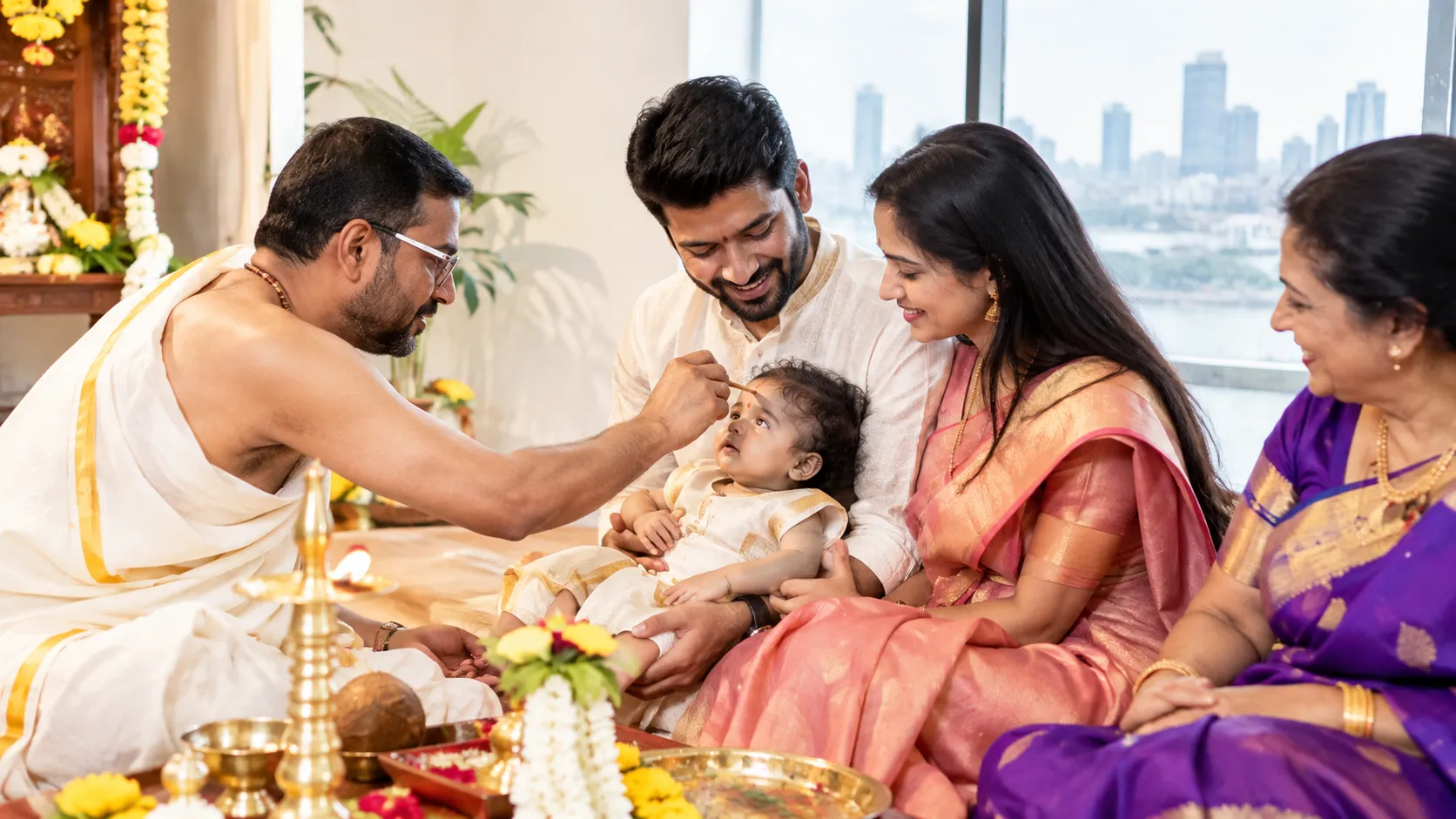
The namkaran, or naming ceremony, is one of the sixteen traditional sanskars in Hindu life, marking the moment a child is formally given a name that will accompany them for life. For families living in Melbourne, balancing this ritual with modern schedules and hospital routines can feel like a puzzle, but it does not have to be complicated once you understand the basic structure.
Understanding the Namkaran Ceremony in Hindu Tradition
Namakarana, commonly called namkaran, comes from Sanskrit roots meaning "the act of naming." In traditional Vedic thought, a name is not just a label. It is believed to carry sound vibrations that influence the child's identity, temperament, and early experiences of the world.
This is why the naming ceremony is treated with such care in Hindu households. The ritual typically involves:
- Invoking blessings from deities and ancestors for the child's wellbeing
- A formal announcement of the chosen name in front of family
- Whispering the name into the baby's ear, often by the father or an elder
- Sacred fire rituals (havan) in many regional traditions
- Blessings from grandparents, relatives, and the presiding priest
Across India and now within the Australian diaspora, the namkaran ceremony (Hindu families sometimes also call it the naming day) remains one of the most anticipated early milestones for a newborn.
Regional customs vary quite a bit across India, and those variations often carry over into how families in Australia choose to celebrate. Some prefer a simple home gathering, while others invite extended family and hold a more elaborate function with full Vedic chanting.
When Should the Naming Ceremony Take Place?
Traditionally, namkaran is performed on the eleventh or twelfth day after birth, though many families today schedule it later to accommodate recovery time, travel for relatives, or simply to allow the new parents some breathing room. In my experience, most Melbourne families end up holding the ceremony somewhere between two and six weeks after birth, once things have settled at home.
Timing is not arbitrary in Vedic tradition. Astrologers typically look at the panchang (the Hindu calendar) alongside the baby's birth details to identify an auspicious date and time, known as a muhurat. This is also usually when the child's nakshatra (birth star) is calculated, since many families choose a name whose first syllable aligns with the sound associated with that nakshatra.
If you are unsure where to start, a kundali vishleshan in Melbourne can help clarify the child's birth chart details before the naming date is finalized. This is often the step families skip, and then wonder later why the date they picked did not feel quite right.
The Hindu Naming Ceremony Procedure, Step by Step
While every family and regional tradition adds its own touches, the general hindu naming ceremony procedure tends to follow a familiar arc.
Preparation Before the Ceremony
Before the day itself, a few things are usually arranged:
- A short list of proposed names, often narrowed down using the child's nakshatra
- Consultation with a priest or astrologer to confirm an auspicious date and time
- A simple puja setup, including items like rice, betel leaves, a small oil lamp, and flowers
- Invitations to close family, since this is traditionally an intimate gathering rather than a large event
On the Day of the Ceremony
The ceremony itself is usually brief, often lasting between thirty minutes and an hour depending on how elaborate the rituals are. A typical sequence includes prayers to Lord Ganesha for an auspicious beginning, a small havan or lamp lighting, and the formal naming moment where the chosen name is announced and whispered into the child's ear.
Family members often take turns blessing the baby, sometimes placing a small amount of honey or a drop of ghee on the child's tongue as part of regional customs, though this varies and should always be discussed with a pediatrician first given modern feeding guidance.
After the Naming
Once the name is announced, it is common for the family to share a meal together. Some families also use this occasion to perform other early rituals for the child, which is where understanding the broader framework of Vedic Child, the 16 Sanskars, becomes genuinely useful. Namkaran is just one of these milestone rituals, and knowing what comes before and after (such as Jatakarma at birth or Annaprashan when solid food is introduced) helps parents plan ahead rather than scrambling for each ceremony separately.
Naming Ceremony Rituals in Hindu Households Across Australia
Living outside India does not mean these traditions need to be diluted. In fact, many Melbourne families put real thought into keeping the naming ceremony rituals in Hindu custom intact while adapting logistics to local life. Common adjustments include holding the ceremony over a weekend so extended family can attend, using online video calls for grandparents who could not travel, or condensing multi-day traditional functions into a single afternoon.
An indian naming ceremony held in Melbourne today often blends the same core Vedic structure with a schedule that works for a modern, dual-career household.
What matters most, from what I have observed working with families here, is not the scale of the event but the intention behind it. A quiet ceremony at home with a handful of relatives carries the same spiritual weight as a large hall function, provided the core rituals, the muhurat, and the priest's guidance are respected.
Choosing a Name: More Than Just Personal Preference
Hindu naming conventions often draw from several sources at once. Families might consider:
- The nakshatra-based starting syllable, determined from the baby's birth chart
- Names of family deities or revered ancestors
- Meaning and phonetic sound, since certain sounds are traditionally associated with specific planetary energies
- Modern practicality, such as how the name will be pronounced and understood in an Australian context
This last point matters more than families sometimes expect. A name that flows beautifully in Sanskrit can occasionally be mispronounced constantly in an English-speaking classroom or workplace. Many parents in Melbourne now choose a name that honors tradition while also being easy to pronounce locally, sometimes selecting a shorter form or a widely recognized transliteration.
Astrologers may interpret certain nakshatra and planetary placements as more favorable for particular sound groups, but this should be treated as traditional guidance rather than a rigid rule. The final decision always rests with the parents, and no astrological reading should be treated as an obligation.
Common Mistakes Families Make
A few patterns come up repeatedly when families are planning this ceremony:
- Leaving the date until the last minute. Auspicious muhurats need calculation time, especially if a priest needs to check the panchang alongside the child's exact birth details.
- Not consulting anyone about the nakshatra. Some parents choose a name purely on sound preference, then later wish they had checked the birth star alignment first.
- Overcomplicating the guest list. This is traditionally a family-centered event, not a large celebration, and trying to make it one can add unnecessary stress during an already demanding newborn period.
- Skipping the priest's guidance entirely. While it is possible to perform a simplified version at home, working with someone experienced in the rituals ensures nothing important is missed.
The Role of a Priest in the Ceremony
A trained priest brings more than just Sanskrit chanting to the day. They typically help confirm the muhurat, guide the family through each ritual step in the correct order, and explain the significance of each part as it happens, which many families find adds real meaning to the occasion rather than it feeling like a formality.
For families in Melbourne looking for support with this, working with an experienced Hindu Pandit in Melbourne can make the entire process smoother, from date selection through to the ceremony itself. At Astro Shivang, ceremonies are guided with attention to both traditional accuracy and the practical realities of organizing a home-based function in Australia.
If you are also weighing up options among several priests, it can help to understand what distinguishes an experienced practitioner. Reading through guidance on finding the Best Indian Pandit in Melbourne can give you a clearer sense of what questions to ask before booking someone for such a personal family occasion.
What to Prepare Before Contacting a Priest
Before reaching out, it helps to have a few details ready:
- The baby's exact date, time, and place of birth (for nakshatra calculation)
- A rough idea of preferred dates based on family availability
- Any regional or family-specific customs you would like included
- A short list of name options, if you already have some in mind
Having this information ready generally makes the consultation faster and more productive, since the priest can move straight into checking the panchang rather than gathering basic details first.
Bringing Tradition and Modern Life Together
Raising a child between two cultures is something many Hindu families in Australia navigate daily, and the naming ceremony is often the first cultural milestone a child experiences. Astro Shivang works with families across Melbourne and beyond to keep these traditions meaningful without making them feel out of step with everyday Australian life. Whether the ceremony is a small home gathering or a larger family function, the goal remains the same: giving the child a name rooted in tradition, blessed with intention, and chosen with care.