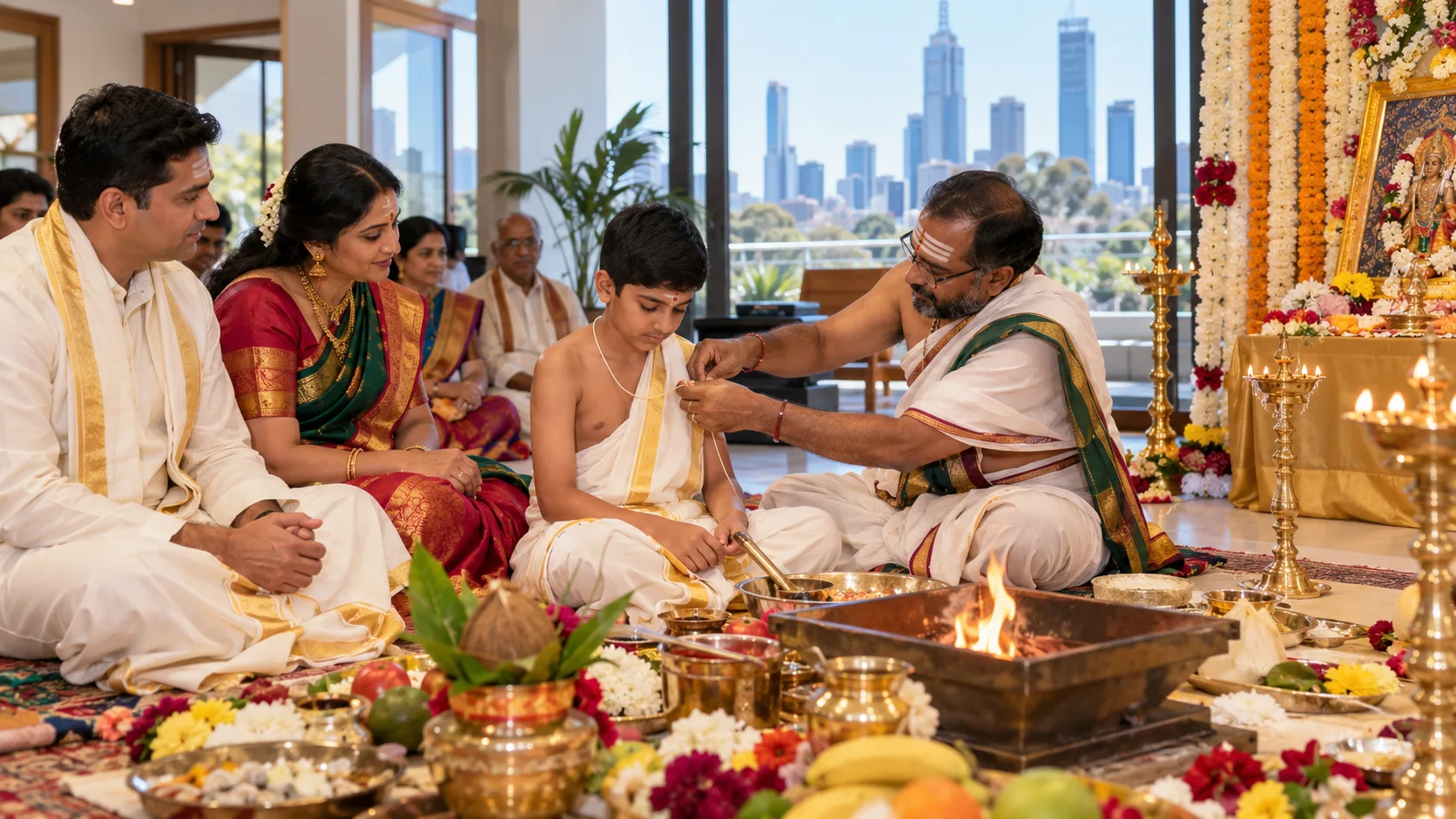
This guide covers the meaning, the ritual, the age, the muhurat and the local planning, so you can approach the day with clarity.
Janeu Sanskar Meaning: What the Sacred Thread Represents
Upanayan literally means "bringing near". Traditionally the child is brought near a teacher and a stream of learning, and formally begins a phase of study and discipline. The janeu, also called yajnopavita, is the sacred thread given during the ceremony and worn over the left shoulder.
Its three strands are read in different ways. Some traditions link them to duties toward gods, sages and ancestors, others to the three gunas. The thread stands for responsibility and self-discipline, not status.
You'll also hear the word "dvija" (twice-born). In its traditional sense it points to a second, educational and spiritual birth. It's a cultural and religious concept, understood differently across communities.
Where Upanayan Fits Among the 16 Sanskars
The 16 sanskar in Sanatan Dharma are the life-cycle rites that mark a person's path from before birth to the final rites. In most lists upanayan comes after childhood rites such as Vidyarambha (the start of learning) and before Vedarambha (the start of Vedic study). Lists differ a little between texts.
If you'd like the whole sequence in one place, our page on Vedic Child – 16 Sanskars explains each stage. Upanayan is the point where the child moves from being cared for to taking on learning and responsibility.
What Happens During an Upanayan Sanskar
Details vary by region and lineage, but most ceremonies follow this general shape:
- Preparation: The family sets up the sacred space, and the boy usually has his hair trimmed or shaved before the ritual.
- Bath and clothing: He bathes and dresses in simple traditional clothing, often a dhoti.
- Ganesh puja and havan: Prayers open the ceremony, and offerings are made into the sacred fire.
- The sacred thread: The pandit ties the janeu with mantras, and the child begins wearing it.
- The Gayatri mantra: Traditionally the father or teacher whispers the mantra into the child's ear. This is the heart of the rite.
- Staff and alms: In many traditions the boy carries a staff and asks for alms from his mother and other elders, symbolising humility.
- Blessings and a family meal: Elders bless him, and everyone shares prasad.
Some South Indian families include a playful custom in which the boy sets off "to Kashi" to study, and his maternal uncle persuades him to return. It's a regional custom, not a universal part of the rite.
The Right Age for Upanayan
Classical texts mention different ages for different communities, commonly eight, eleven and twelve, and some traditions count years from conception. Practice today is much more flexible.
Many families hold the ceremony before adolescence, often between roughly seven and twelve, while others do it later. There's no single rule for every family.
In my experience, the more useful question is readiness. Can your child sit calmly through the ritual, repeat a few mantras and understand, at his own level, that this is a moment of learning?
Traditions differ on who is initiated. Many families follow the practice for boys, while some traditions, including Arya Samaj, also initiate girls. If this matters to your family, discuss it openly with your elders and your pandit.
Choosing a Muhurat for Upanayan
Upanayan is one of the rites where timing is traditionally treated with special care. A pandit typically checks the panchang for suitable tithi, nakshatra and weekday. Many practitioners also avoid periods when Jupiter or Venus is combust, and some texts prefer the period of Uttarayan, when the sun travels north.
In Melbourne that period runs from mid-summer to mid-winter, so a preferred window can fall on a cold day. Timings are calculated from local sunrise, so a panchang written for India will give the wrong hours. Victoria's daylight saving also shifts the clock, and it's worth double-checking times in local terms.
Astrologers may also consider the child's birth details. This is traditional guidance, not a guarantee of outcomes, and it shouldn't be a source of worry.
Planning Your Upanayan Sanskar in Melbourne
The ceremony is longer and more involved than a naming or first-rice rite, so it helps to plan early. Families here usually choose among three settings:
- Home: Intimate and familiar. Our page on Hindu Priest for Home Ceremonies explains what a home ceremony involves.
- Community hall: Better for larger guest lists, though you should ask about rules on open flame.
- Temple: Some offer facilities, so check their booking process.
A few practical points can save stress:
- Choose a date that works around school terms, exams and sport.
- Check smoke alarms and building rules before a havan.
- Keep the space warm if the date falls in winter, since the boy may be bare-chested for part of the ritual.
- Let grandparents and relatives join by video if they can't travel.
- Arrange vegetarian catering for guests.
Astro Shivang is based in Truganina and works with families across Melbourne and other parts of Australia. If you're searching for an upanayan pandit near me, look for someone who explains each step, calculates the muhurat for Melbourne and adapts the rites to your home.
Preparing Your Child for the Day
A child who understands what's happening usually enjoys it far more than one who's surprised by it. A few gentle steps help:
- Explain the meaning in simple words and let him ask questions.
- Practise the Gayatri mantra together, at his own pace.
- Try the traditional clothing beforehand so it feels comfortable.
- Tell him who will hold which part of the ritual.
- Keep expectations light; it's a milestone, not a test.
Life After the Ceremony
The ceremony is a beginning. Traditionally the janeu is worn daily, and many families encourage a short daily practice such as sandhyavandanam or a few minutes of mantra. Some communities also renew the thread each year on a set festival day.
Modern life makes some routines hard, and that's normal. Agree with your child on a realistic practice that he can keep up, rather than an ideal he'll drop within a week.
Common Misconceptions
- "It's only a formality." For many families, it's a meaningful moment of commitment to learning.
- "It has to be huge." A small, well-conducted ceremony is complete.
- "One custom fits every family." Rites vary widely between regions and lineages.
- "Missing the traditional age is a problem." Traditions are generally flexible when there's a genuine reason.
How a Pandit Can Help
You can prepare a great deal yourself, but the mantras, sequence and timing of upanayan are detailed, and most families prefer a knowledgeable pandit. A Hindu Pandit in Melbourne can explain each step to the child and the guests as it happens. Families comparing options sometimes look at our page on the Best Indian Pandit in Melbourne, and it's sensible to ask any pandit how they'd handle your family's customs.
Before you speak to one, have ready your child's birth details, your family gotra and lineage customs, preferred dates, expected guest numbers and the venue.
Planning Your Child's Upanayan with Confidence
Start with your family's tradition, choose a window that suits your child, get the muhurat calculated for Melbourne and prepare him gently. That's most of what makes the day go well.
If you'd like to talk it through, Astro Shivang is happy to help you understand the rites and plan the ceremony. You can reach us on +61 433 710 113 whenever you're ready.