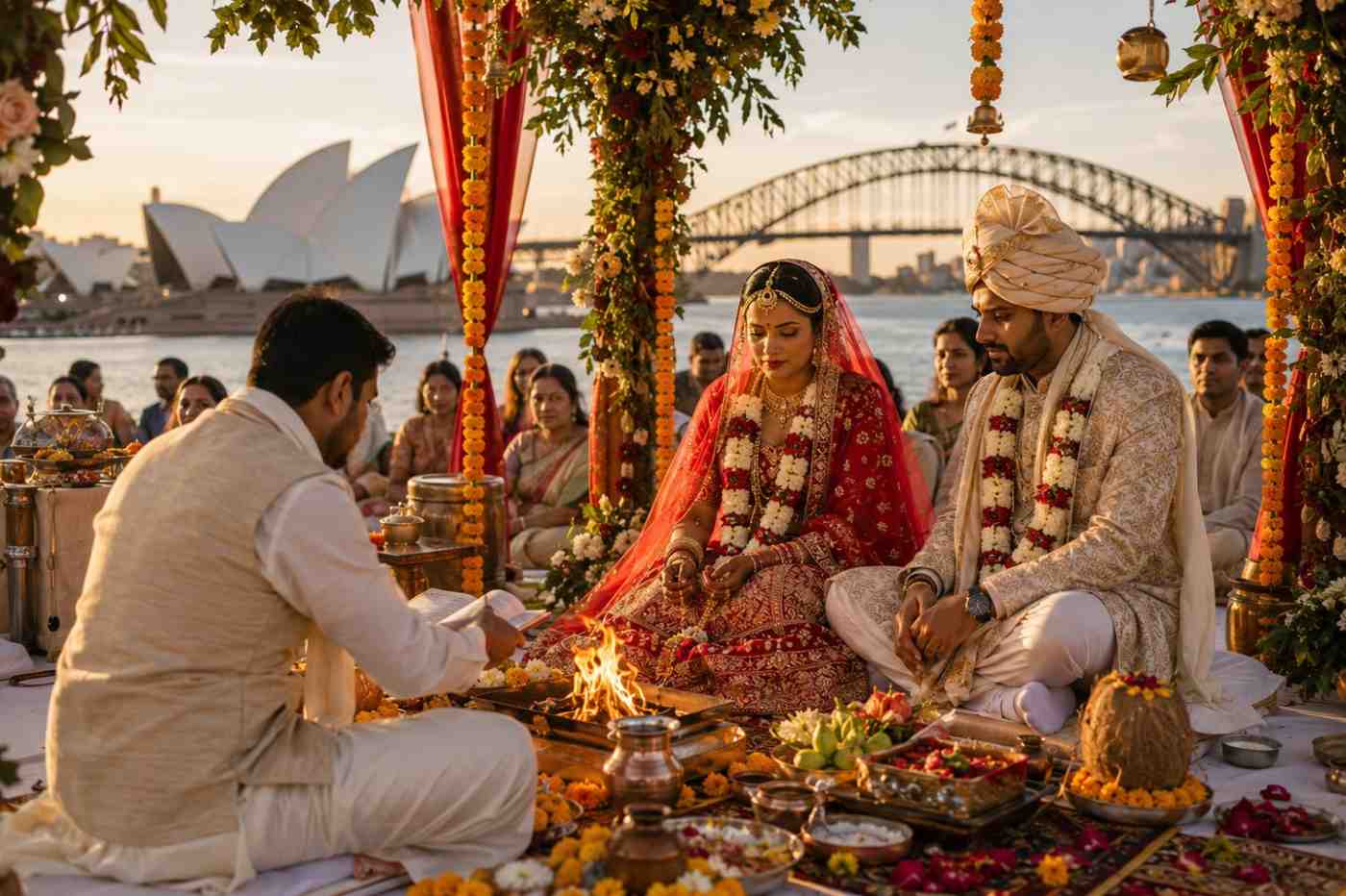
If you're planning a Hindu wedding in Australia, you already know it's not "just a wedding." It's a few days of colour, music, mantras, family chaos (the good kind), and rituals that have been passed down for generations. The tricky part? Recreating all of that magic thousands of kilometres away from home.
The good news — you don't have to choose between tradition and location anymore. From Sydney to Melbourne, Perth to Brisbane, Australia now has a thriving Indian community, and with it, genuine Vedic wedding rituals conducted by qualified, experienced Pandits who understand both the scriptures and the practical side of planning a destination-style wedding on foreign soil.
At Astro Shivang, we've had the honour of guiding hundreds of couples through this exact journey — matching kundlis, choosing an auspicious wedding date, and standing beside families as their Hindu Pandit in Sydney for weddings or their trusted Pandit for marriage in Melbourne. This guide walks you through everything you need to know about planning an authentic Indian wedding in Australia in 2026, ritual by ritual.
Why Indian Weddings in Australia Are Booming in 2026
Australia's Indian diaspora has grown massively over the last decade, and so has the demand for authentic ceremonies. More couples — especially second-generation Indian-Australians — want their wedding to actually feel Indian, not just look like it in photos. That means real Sanskrit mantras, a Pandit who explains the meaning behind each step, and rituals performed with the same devotion you'd find in Delhi, Jaipur, or Chennai.
The shift is real: families are no longer settling for a rushed, generic ceremony. They're actively searching for a genuine Hindu Priest in Sydney for wedding ceremonies, someone who can perform the full Saptapadi with the correct vidhi, not a shortened, "Australianised" version.
Getting the Timing Right: Why Muhurat Still Matters
Before venues, outfits, or guest lists, Indian families ask one question first — "What's the shubh muhurat?" And honestly, that instinct is correct.
In Vedic astrology, marriage isn't just a legal or social event — it's considered a sacred union of two horoscopes, two families, and two energies. The date and time you choose can influence the harmony, prosperity, and stability of the marriage ahead. This is why kundli matching (Guna Milan) and muhurat calculation are usually the very first steps we take at Astro Shivang, long before the venue gets booked.
A few things a qualified astrologer checks while selecting your 2026 wedding date:
- Compatibility between both birth charts (Ashtakoot Milan)
- Auspicious tithis, nakshatras, and planetary positions
- Avoiding inauspicious periods like Rahu Kaal or certain eclipses
- Family-specific factors, such as Mangal Dosha or Nadi Dosha, if present
If you're unsure where to start, this is exactly the kind of guidance Astro Shivang provides for couples across Australia — combining traditional Vedic astrology with practical scheduling around venue and guest availability.
The Pre-Wedding Rituals: Setting the Spiritual Tone
Roka and Engagement
This is the informal "yes, we're doing this" moment between families. A simple puja is often performed to seek blessings before the formal proceedings begin.
Ganesh Puja
Every major Hindu ceremony begins by invoking Lord Ganesha, the remover of obstacles. Before any wedding ritual starts, a small Ganesh Puja is performed at home to ensure the days ahead go smoothly.
Haldi Ceremony
The turban-yellow, joyful, slightly messy haldi ceremony is a favourite for a reason. Turmeric paste is applied to the bride and groom (usually separately) by close family members. Beyond the fun and photos, haldi is believed to purify the body and spirit before the wedding, and it also carries an auspicious, protective significance in Vedic tradition.
Mehendi
While not a strictly religious ritual, mehendi has become an inseparable part of Indian weddings — intricate henna designs symbolising love, prosperity, and the bond between partners.
Sangeet
An evening of music, dance, and family bonding. Again, more cultural than religious, but it's become a core part of how Indian weddings are celebrated in Australia today.
The Wedding Day: Core Vedic Rituals
This is where an experienced Pandit truly makes the difference. A wedding conducted with proper vidhi doesn't just look right — it feels right, both spiritually and emotionally, for the families involved.
Baraat — The groom's arrival procession, traditionally accompanied by dhol, dance, and celebration.
Var Mala / Jaimala — The exchange of flower garlands between bride and groom, symbolising mutual acceptance.
Kanyadaan — One of the most emotional moments of the day, where the bride's father formally "gives away" his daughter, entrusting her wellbeing to the groom.
Mangal Pheras / Saptapadi — The seven sacred rounds around the holy fire (Agni), each step representing a vow — nourishment, strength, prosperity, happiness, progeny, long life, and friendship. This is considered the actual moment the marriage is sealed in Hindu tradition.
Sindoor and Mangalsutra — The groom applies sindoor to the bride's hair parting and ties the mangalsutra around her neck, both symbols of marital status and protection.
Saat Vachan — Seven vows exchanged between the couple, promising mutual respect, support, and partnership through life.
Every one of these steps carries deep meaning, and it takes a Pandit who genuinely understands Sanskrit shlokas — not one reading off a phonetic cheat sheet — to translate that meaning for a modern Australian-Indian audience, many of whom are experiencing it for the first time in English.
Finding the Right Pandit in Australia
This is usually where couples get stuck. Australia has a growing number of priests offering wedding services, but experience and authenticity vary a lot. Here's what we'd suggest checking before you book:
- Experience with full-length ceremonies — not just a 20-minute version.
- Ability to explain each ritual in simple English for family members who may not follow Sanskrit or Hindi fluently.
- Flexibility with venue requirements — many Australian wedding venues have fire and smoke restrictions, so your Pandit needs to know how to adapt the havan respectfully.
- Availability for pre-wedding poojas too — Ganesh Puja, Griha Shanti, or Mata ki Chowki, if your family wants them.
If you're getting married in New South Wales, look for a dedicated Hindu Pandit in Sydney for weddings who has actually performed ceremonies at local Australian venues before — the small logistical knowledge (fire alarms, indoor havan setups, timing around venue slots) genuinely makes a difference on the day.
Similarly, if your wedding is in Victoria, a Pandit who regularly works as a Pandit for marriage in Melbourne will already understand the local venues, community priests network, and how to plan around Melbourne's unpredictable weather for any outdoor rituals.
Adapting Traditions for an Australian Setting
A few practical realities of getting married in Australia that most guides don't mention:
- Fire restrictions: Many venues don't allow open havan fires indoors. A good Pandit will know how to perform the Agni ritual using approved, safe alternatives without losing its sanctity.
- Time zones for muhurat: Shubh muhurat calculations need to be adjusted for Australian time zones, not simply copied from an Indian panchang.
- Multi-day scheduling: Fitting Haldi, Mehendi, Sangeet, and the wedding into a realistic Australian weekend (most guests can't take a week off work) often means combining or compressing events without cutting corners on ritual significance.
- Multi-cultural guest lists: Many ceremonies now include a short explanation in English before each ritual, so non-Indian guests can appreciate what's happening and why.
This is exactly the kind of planning support Astro Shivang offers — not just performing the puja, but helping families sequence the whole event so nothing important gets rushed or skipped.
Why Couples Across Australia Choose Astro Shivang
With over a decade of experience in Vedic astrology and puja services, Astro Shivang has supported families across Melbourne, Sydney, and beyond — from kundli matching and muhurat selection to the actual wedding-day rituals performed with complete devotion and correct vidhi.
Whether you need a Hindu Priest in Sydney for wedding ceremonies who can walk your guests through every ritual with warmth and clarity, or a dependable Pandit for marriage in Melbourne who treats your family's traditions with the same respect they'd receive back home, our approach stays the same: authentic rituals, explained simply, performed with heart.
We also help with:
- Kundli Milan and Mangal Dosha analysis before the wedding
- Selecting the most auspicious 2026 wedding dates
- Griha Pravesh Puja for newlyweds moving into a new home
- Pre and post-wedding remedies for a harmonious married life
Final Thoughts
An Indian wedding, wherever it happens in the world, is ultimately about intention — the blessings you invoke, the vows you take seriously, and the family bonds you strengthen along the way. Australia has become a genuine home for these traditions, and with the right guidance, your 2026 wedding can carry every bit of the warmth, meaning, and sacredness it would back in India.
If you're starting to plan your wedding and want guidance on muhurat, kundli matching, or booking an experienced Pandit, Astro Shivang is here to help — from the first phone call to the final phera.
📞 Australia: +61 433 710 113 💬 WhatsApp: Chat with Astro Shivang 📧 Email: astroshivang@gmail.com