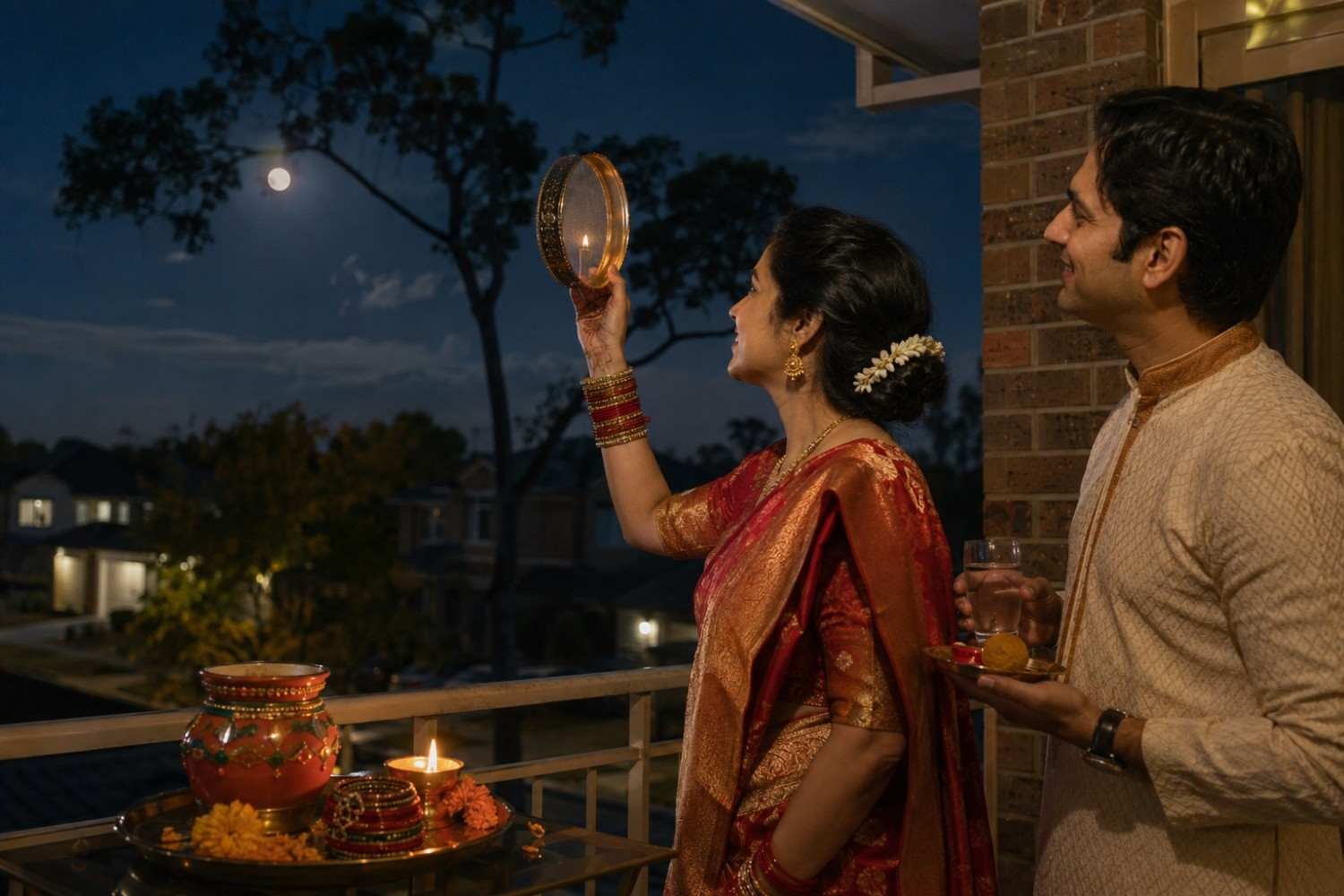
If you keep Karwa Chauth in Australia, you already know the biggest question of the day: "When will the moon actually come out?"
Back home in Delhi or Punjab, the answer is around 8:15 PM. Here it's a very different story. This year the moon rises much later in the evening in Melbourne and Sydney, and many families are surprised by it. At Astro Shivang, we get this exact question every October, so we've put everything in one simple guide: the date, the moonrise times for Melbourne, Sydney and Brisbane, and practical tips to get through the day.
Quick Answer: Karwa Chauth 2026 Moonrise Times in Australia
Karwa Chauth 2026 falls on Thursday, 29 October 2026 in Australia, the same calendar date as India.
| City | Sunrise | Sunset | Moonrise (approx.) | Fasting hours (approx.) |
|---|---|---|---|---|
| Melbourne | 6:17 AM | 7:51 PM | 11:49 PM | about 17.5 hrs |
| Sydney | 5:58 AM | 7:20 PM | 11:09 PM | about 17.2 hrs |
| Brisbane | 4:59 AM | 6:04 PM | 9:41 PM | about 16.7 hrs |
These times were calculated astronomically for each city centre, using daylight saving time for Melbourne and Sydney (which began on 4 October) and standard time for Brisbane. Your suburb can differ by a few minutes, and the moon usually looks clear 10 to 15 minutes after it technically rises, so please confirm with your local panchang, such as Drik Panchang, before you break your fast.
For a few other cities, the moon rises roughly around 11:22 PM in Canberra, 11:35 PM in Adelaide and 10:30 PM in Perth.
Why Is Moonrise So Late in Australia?
This is the part that confuses most people, so let's explain it simply.
Karwa Chauth always falls on the fourth day after the full moon (Krishna Paksha Chaturthi in the month of Kartik). By then the moon is no longer full. It is a waning moon, and every night it rises a little later than the night before, roughly 45 to 60 minutes later each day.
This year the full moon is just a few days before Karwa Chauth, so by the evening of the 29th the moon is about 85% lit and rises late at night. In Delhi that works out to around 8:15 PM. In Melbourne, because of where we sit on the globe and because daylight saving has moved our clocks forward, it lands close to midnight.
It has nothing to do with doing anything wrong, and it isn't a mistake in your calendar. It is simply how the moon and the clocks line up in Australia this year.
What Is Karwa Chauth?
Karwa Chauth is a well-loved fast, especially in North Indian families. The name comes from two words: karwa, the small earthen pot used to offer water to the moon, and chauth, meaning the fourth day. Traditionally, married women fast from sunrise until they see the moon, praying for the health, happiness and long life of their husbands. In many families today, husbands fast too, and some unmarried women keep the fast as well.
The day usually includes:
- Sargi: a pre-dawn meal, often given by the mother-in-law
- A day-long fast, traditionally without food or water (nirjala)
- An evening puja with the Karwa Chauth katha (the story of Veervati is the most popular)
- Moon sighting through a sieve (chalni), followed by arghya (offering water)
- Breaking the fast with the first sip of water and a bite of food from the husband
Whatever your family's version looks like, the heart of the day is love, patience and togetherness.
The Date: 29 October in Australia
The Chaturthi tithi (the lunar day that Karwa Chauth follows) begins early on 29 October and runs until the early hours of 30 October in Australia. Roughly, that is from about 6:36 AM AEDT on the 29th to about 3:39 AM on the 30th in Melbourne and Sydney (and about an hour earlier in Brisbane). Because the tithi is present through the whole evening and moonrise, the vrat is kept on 29 October.
You may see some websites saying 28 October. That date applies to North America, where the tithi and moonrise arrive on the previous calendar day. A few pages also list 28 October for India, so it's always worth checking your local panchang. In Australia, Thursday 29 October is the date most panchangs give.
How Your Day Might Look in Melbourne, Sydney or Brisbane
Here is a simple, realistic plan. Adjust it to your family's custom.
Before sunrise: Sargi
Have your Sargi in the early hours, before dawn. Foods that keep you going longer include dry fruits, fruit, paratha, a light sabzi, sweets like feni and coconut. Don't eat too heavy or too salty, as that makes you thirstier later.
Daytime: Rest and prayer
Keep the day calm. Read the katha, decorate the thali, apply mehndi (many families do this the night before), and try to rest in the afternoon. Save your energy for the evening.
Around sunset: Puja and katha
The Delhi puja muhurat of about 5:38 PM to 6:56 PM is for India's time zone. It does not apply to Australia. Here, families generally gather in the evening around and after local sunset (about 7:51 PM in Melbourne, 7:20 PM in Sydney and 6:04 PM in Brisbane) for the puja and katha. If you want an exact muhurat for your suburb, check a panchang or ask your pandit ji.
Night: Moon sighting
Wait for the moon to rise. In Brisbane that's around 9:41 PM, which is a comfortable evening. In Sydney and Melbourne it's near 11 PM to midnight, so plan your night accordingly.
After moonrise: Arghya and breaking the fast
Look at the moon through the sieve, offer water from the karwa, then look at your husband through the sieve. He offers you the first sip of water and a bite of food. Then you can have a proper meal.
Practical Tips for a Late Moonrise
Since the wait is long in Sydney and Melbourne, these small things help a lot:
- Plan dinner ahead. Keep something light and warm ready, like khichdi, dal or soup, so you can eat gently after the fast instead of overeating.
- Sleep and rest in the afternoon. Even 30 to 40 minutes makes a real difference.
- Find a clear view of the east/north-east. In late October the waning moon rises in the east. A backyard, balcony or open park works better than a spot surrounded by tall buildings. Apps like Stellarium or PhotoPills can show you exactly where to look.
- Check the weather. Melbourne evenings can be cloudy. If the moon is hidden, many families follow their tradition of breaking the fast on the moonrise time even when it can't be seen. Ask your family elders or pandit ji what your community does.
- Plan the get-together. A late night is easier when it's a small family gathering with music, chai or a video call with relatives abroad.
- Prepare the thali the day before. Diya, karwa, chalni, roli, rice, mithai and flowers, all ready.
A Gentle Word on Health
A full-day nirjala fast of around 17 hours is demanding, especially in warm weather. Please take care.
- If you are pregnant, breastfeeding, diabetic, or on regular medication, or you have any health condition, speak with your doctor first.
- If you feel dizzy, faint or unwell during the day, it is completely fine to break the fast. Your health and your family's peace matter more than any strict rule.
- Many families today choose a fast with water, fruit or juice instead of nirjala, and that is a personal decision.
Traditions are meant to bring blessings and closeness, not stress or harm.
Karwa Chauth Puja Samagri Checklist
- Karwa (earthen or brass pot) with a lid
- Chalni (sieve)
- Puja thali with diya, roli, chawal (rice), haldi and kumkum
- Fresh flowers
- Mithai and fruit
- Sargi items
- Karwa Chauth katha book or a printed copy
- Solah shringar: red or auspicious clothes, bangles, bindi, sindoor and mehndi
- Water and a plate for arghya
Can't find something locally? Most Indian grocery stores in Melbourne, Sydney and Brisbane stock Karwa Chauth items in the week before the festival, but it's smart to shop early.
Final Thoughts
A late moonrise can feel long, but it's part of what makes Karwa Chauth in Australia its own experience. Plan your day, look after your health, and keep the focus on the love behind the fast, and the wait passes more gently than you'd expect.
If you'd like help with your puja, a pandit ji for a Karwa Chauth katha at home, or guidance on other upcoming festivals like Ahoi Ashtami, Dhanteras and Diwali, the team at Astro Shivang is happy to help. Message us on WhatsApp, book a free 5-minute call, or call +61 433 710 113.
Wishing you a peaceful, joyful Karwa Chauth from all of us at Astro Shivang.